
Getting the data centre energy obligation right is critical to protecting the government’s planned gas reservation for Australian households and businesses. If the obligation doesn’t limit how much gas data centres can use, they could compete with households and manufacturers for scarce supply. Our analysis shows data centres could absorb much of the gas the reservation sets aside for Australian homes and businesses.
Clear limits on gas are needed to protect the proposed gas reservation
Australia’s east coast gas is already heavily committed, with about 75% shipped overseas as liquefied natural gas (LNG) from Curtis Island near Gladstone. From 2028, a new gas reservation scheme will require LNG exporters to reserve up to 20% of new export volumes for the domestic market. This could make up to 200 petajoules (PJ) of gas a year available for Australian homes and businesses.
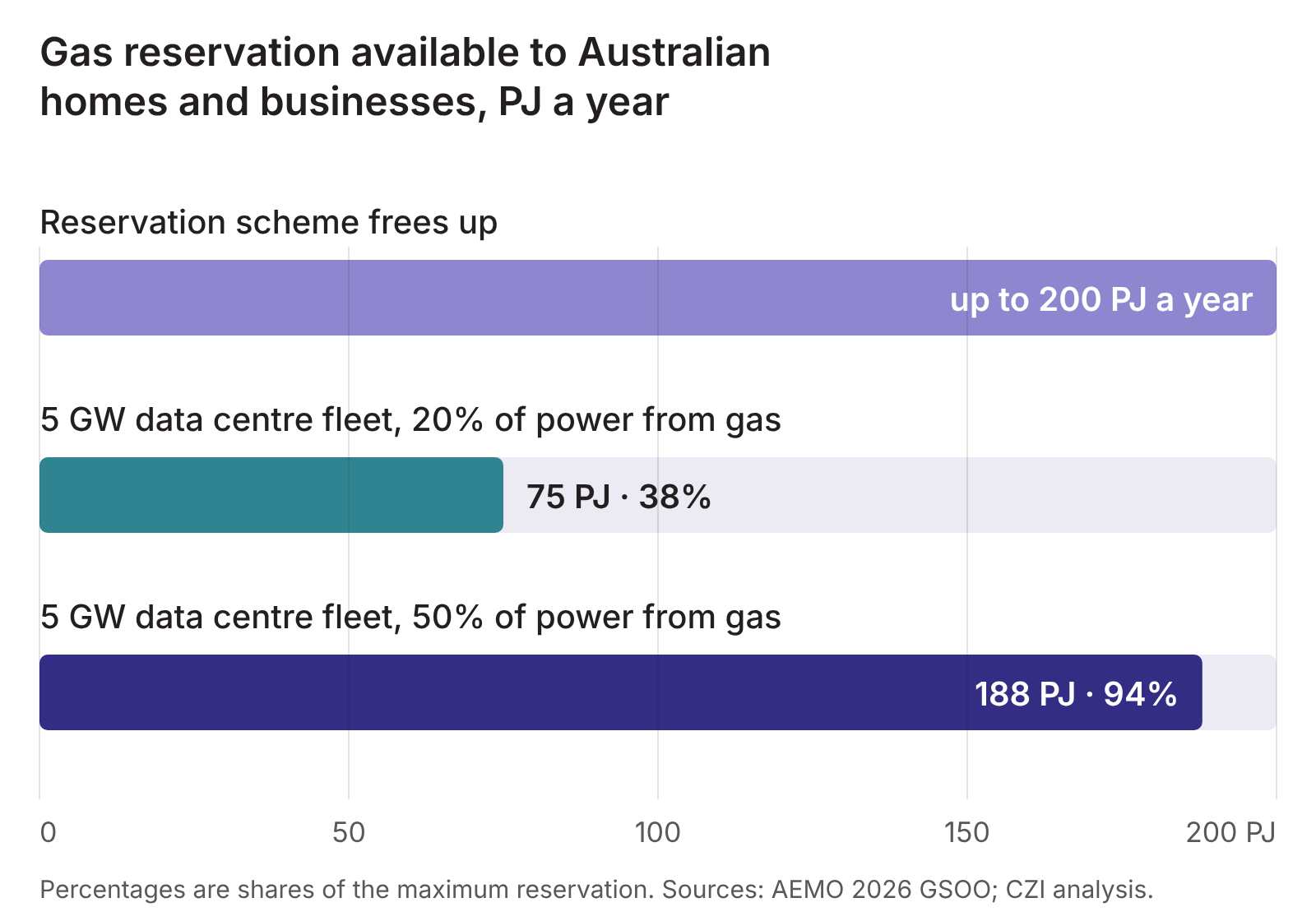
If a 5 GW data centre fleet drew 20% of its power from gas, it would burn about 75 PJ a year, or 38% of the maximum supply projected to be available for the reservation. At 50%, it would burn about 188 PJ, which is 94% of that maximum.
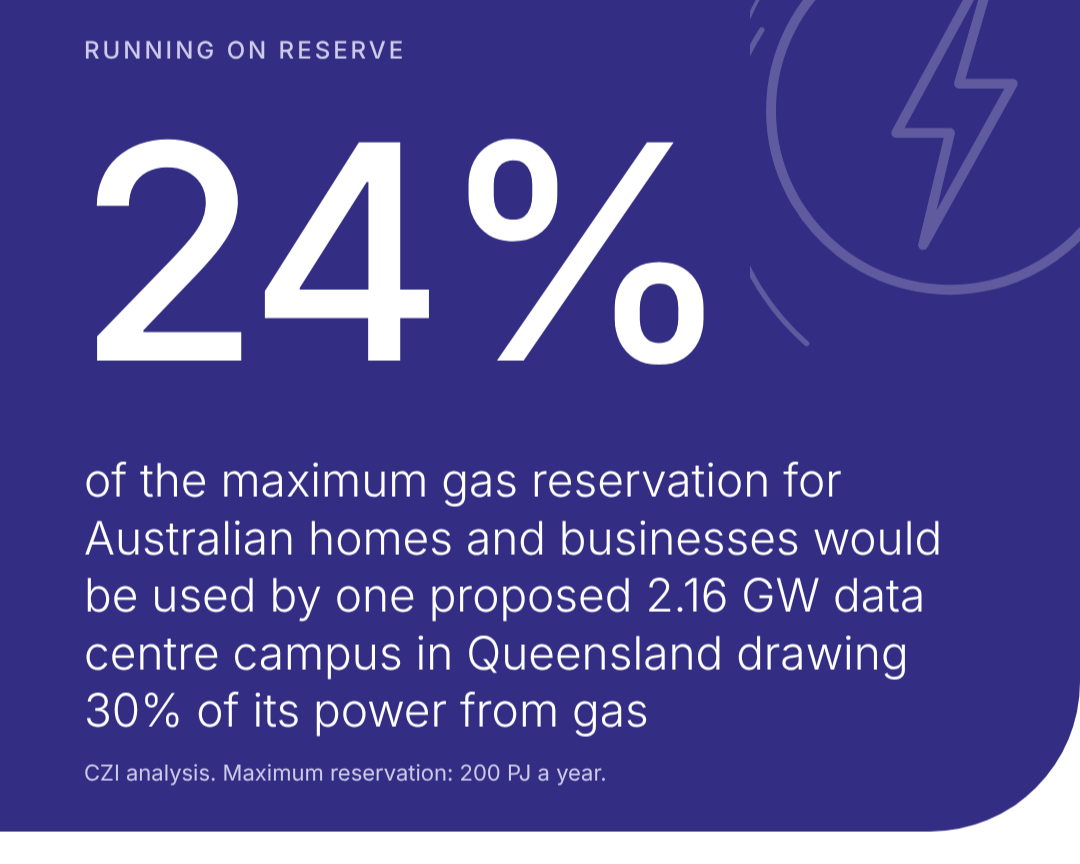
A single project can make a large difference. Zerra DC’s proposed 2.16 GW Western Downs Digital Park in Queensland, where Anthropic has agreed to lease the first stage, is one example. In a hypothetical case where the full campus drew 30% of its power from gas, it would use around 24% of the maximum reservation (CZI analysis). A Queensland carve-out that relies on state-owned gas generators would add further to this pressure.
Gas costs more and takes longer to build
Gas is also more expensive than the alternative. New gas as the main fuel costs $135 to $204 per megawatt hour (MWh), compared with $104 to $147 for firmed renewables, according to CSIRO and AEMO’s GenCost 2025–26 report. New gas generation connected via the grid also takes four to eight years to arrive, because order books for large gas turbines are full.
Our recommendation: clean firming first, gas capped
Data centres should firm their supply with batteries and other clean technologies, keeping gas in reserve for industrial users that support Australian manufacturing and small businesses. Firming with gas should be minimal and tightly capped at 5–10%.
Key terms
Petajoule (PJ) is a unit of energy used to measure large volumes of gas.
Liquefied natural gas (LNG) is gas cooled to a liquid so it can be shipped overseas.
The gas reservation scheme requires LNG exporters to reserve part of their gas for Australian users.
References
AEMO, 2026 Gas Statement of Opportunities, 2026
CSIRO and AEMO, GenCost 2025–26 Final Report, 2026
GE Vernova, GE Vernova reports second quarter 2026 financial results, 2026
IT Brief Australia, Anthropic leases first stage of Queensland data campus, 2026
Minister for Resources, Securing more affordable gas for Australians, 2026